Advertisement

ROYAL FAMILY


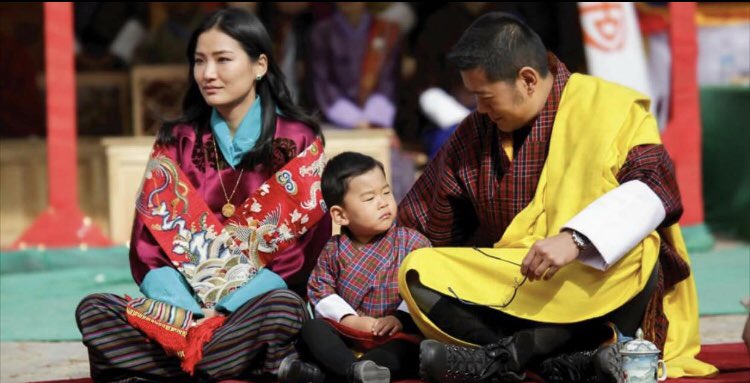
Image result for ROYAL FAMILY OF BHUTAN      HOUSE OF WANGCHUCK

The House of Wangchuck (Tibetan: དབང་ཕྱུག་རྒྱལ་བརྒྱུད་, Wylie: Dbang-phyug Rgyal-brgyud) has ruled Bhutan since it was reunified in 1907. Prior to reunification, the Wangchuck family had governed the district of Trongsa as descendants of Dungkar Choji. They eventually overpowered other regional lords and earned the favour of the British Empire. After consolidating power, the 12th Penlop of Trongsa Gongsar Ugyen Wangchuck was elected Druk Gyalpo ("Dragon King"), thus founding the royal house. The position of Druk Gyalpo is more commonly known in English as King of Bhutan.
The Wangchuck dynasty ruled government power in Bhutan and established relations with the British Empire and India under its first two monarchs. The third, fourth, and fifth (current) monarchs have put the kingdom on its path toward democratizationdecentralization, and development.
There have been five Wangchuck kings of Bhutan, namely:
  1. Ugyen Wangchuck (b.1861–d.1926) "First King"; reigned 17 December 1907 – 21 August 1926.
  2. Jigme Wangchuck (b.1905–d.1952) "Second King"; r. 21 August 1926 – 24 March 1952.
  3. Jigme Dorji Wangchuck (b.1929–d.1972) "Third King"; r. 24 March 1952 – 24 July 1972.
  4. Jigme Singye Wangchuck (b.1955) "Fourth King"; r. 24 July 1972 – 15 December 2006.
  5. Jigme Khesar Namgyel Wangchuck (b.1980) "Fifth King"; r. 14 December 2006 – present.
The ascendency of the House of Wangchuck is deeply rooted in the historical politics of Bhutan. Between 1616 and 1907, varying administrative, religious, and regional powers vied for control within Bhutan. During this period, factions were influenced and supported by Tibet and the British Empire. Ultimately, the hereditary Penlop of TrongsaUgyen Wangchuck, was elected the first Druk Gyalpo by an assembly of his subjects in 1907, marking the ascendency of the House of Wangchuck.

NATIONAL GAME OF BHUTAN

ARCHERY


Since time immemorial Bhutanese have been passionate about their national sport of Dha (archery). Nearly all villages in the kingdom boast an archery range and each dzong has a space set aside nearby for a bha cho (field of target). Competitions are a riot of colour and excitement, with two teams in traditional dress shooting at small wooden targets placed 140m apart (Olympic standard is 50m).

The distance is so great that team members gather dangerously close to the target to yell back how good the archer’s aim was. This is often accompanied by howls, chanting, encouragement and jokes. Members of the opposing team may shout back how terrible the archer’s aim is and make ribald remarks. When an arrow hits the tar­get, team-mates perform a celebratory slow-motion dance and sing the praises of the shooter, who tucks a coloured scarf into his belt. For major tournaments each team brings its own cheerleading section of girls decked out in their finest clothes. They perform dances in between play, and dur­ing the shooting they do brief routines and shout lewd and disparaging comments about the opposing archer’s parentage or sexual prowess.
Tradition has it that women are not allowed to touch an archer’s bow, and it is believed to decrease performance if an archer sleeps with a woman the night before a contest. The traditional Bhutanese archery equipment is a long bamboo bow. Most archers nowadays use a state-of-the-art carbonite Hoyt brand bow with a complicated-looking pulley system that releases the arrows with tremendous speed. The use of imported equipment hasn’t diluted the rich traditions of the game, although Bhutanese archers are now encouraged to train for the Olympics. International coaches who have trained Bhutan’s Olympic archers have been impressed with the natural talent and think that, with expert coaching, Bhutan could possibly win an Olympic medal one day.
The national newspaper, Kuensel, urges young archers, including women, ‘It is time to shoot beyond participation’. The Bhutan National Archery Federation organises two national archery tournaments a year, one with traditional bamboo bows and one open to archers using modern imported equipment. The traditional bow tournament takes place in Dechenchoeling in May. Archery matches are among the most picturesque and colourful events you’ll find here and well worth a visit. There are formal competitions on many weekends, and archers practise most after­noons and weekends when there is no competition. It’s easy to find a session to watch the National Game of Bhutan quite easily when your are travelling around.

national flag

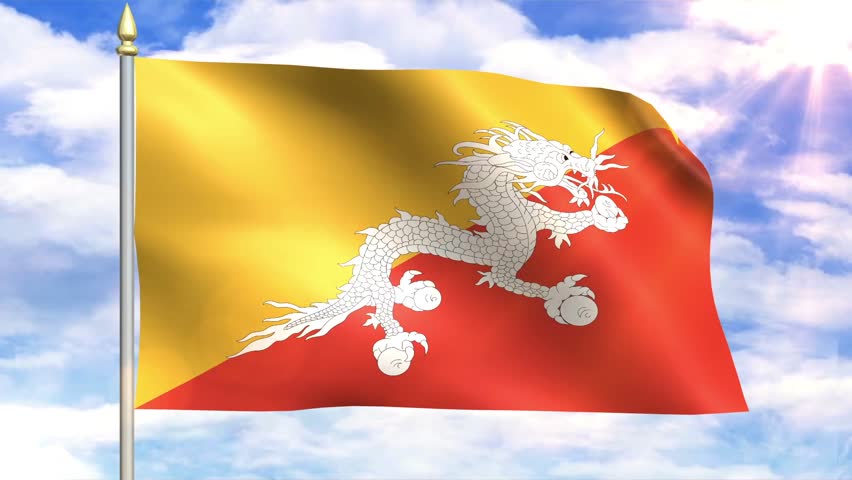
Related image               FLAG OF BHUTAN                                          The national flag of Bhutan (Dzongkha: ཧྥ་རན་ས་ཀྱི་དར་ཆ་) is one of the national symbols of Bhutan. The flag is based upon the tradition of the Drukpa Lineage of Tibetan Buddhism and features Druk, the Thunder Dragon of Bhutanese mythology. The basic design of the flag by Mayum Choying Wangmo Dorji dates to 1947. A version was displayed in 1949 at the signing of the Indo-Bhutan Treaty. A second version was introduced in 1956 for the visit of Druk Gyalpo Jigme Dorji Wangchuk to eastern Bhutan; it was based upon photos of its 1949 predecessor and featured a white Druk in place of the green original.
The Bhutanese subsequently redesigned their flag to match the measurements of the flag of India, which they believed fluttered better than their own. Other modifications such as changing the red background color to orange led to the current design, in use since 1969. The National Assembly of Bhutan codified a code of conduct in 1972 to formalize the flag's design and establish protocol regarding acceptable flag sizes and conditions for flying the flag.

National Bird

Image result for national bird of bhutan                                  RAVEN                                                                                                                                                                                                                                                                                                                                                                                                                                                                                               The Raven is the Bhutan's national bird. It represents one of the most powerful deities of the country, Jarog Dongchen. Raven is thus known in the local language as ‘Jarog’. The Royal Raven Crown or Druk Gyalpo represents Bhutan's reverence for these birds and the faith of Bhutanese in their protective deity. Jarog Dongchen along with Yeshey Gonpo (Mahakala) and Palden Lhamo (Mahakali) form the Divine Trinity, who protects the King and the people of Bhutan from harm and safeguard their well being. At one time, it was a capital crime to kill a Raven in Bhutan. One can still see ravens nesting in monasteries and dzongs throughout Bhutan.

The biological name of Raven is Corvus Corax Tibetanus and is quite similar to the Crow or Corvus Macrorhynchos that is also common in Bhutan. The crow however has larger bill but overall, raven is much larger than a crow and is about 28 inches long. Raven’s tail looks like a wedge, its upper peak has bristles and there are prominent hackles on its throat. Hackles are long, shiny and pointed feather that can be found on raven’s throat and best. Both male and female ravens look alike and are jet blue-black in color. They are commonly found in upland habitation and in alpine and trans-Himalayan regions. During winters, they migrate to lower lands standing at 2300 m. They reside in high altitudes of Tibet, Sikkim, Ladakh and Bhutan.

You can spot a raven at Damthang, Cherithang, Jagothang, Lingshi and Chebesa in Western Bhutan; Bumthang, Dur and Pegula in Central Bhutan and Singye Dzong and surrounding areas in Eastern Bhutan. They can be seen generally in pairs or huddling together by dozens. By nature, ravens are wild, wary, bold and suspicious and love to fly. They are carrions like vultures and can feed on vegetable or animal matter, dead or alive. You can even see them doing acrobatic stunts in high winds and it is not rare to see a raven doing tricks like twisting, turning, sides slipping, looping the loop and nose-diving. Female ravens start building the nest around February from twigs while the make ravens bring moss and hair to make it comfortable for the young ones. Their nests can last for years and only need minor renovations.

Hens give about 5 to 6 eggs at once and incubate them, only to be occasionally relieved by the males. The young ones hatch in 19 to 23 days and for 40 to 42 days, they remain in the nest and are looked after and fed by adults with the food brought in their special throat sac. It has been observed that even the young ones attack large predators trying to approach their nest bravely. It is believed that the guardian Deity, Mahakala, takes the form of a raven to guide the country’s unifier, Shabdrung Ngawang Namgyel, to Bhutan. Namgyel founded Bhutan in the 17th century. The raven-headed form of Mahakala is known as Lego Jaro Dongchen. In 1885, the Trongsa Penlop Jigme Namgyal (father of HM Ugyen Wangchuck, the first king of Bhutan) wore the Raven Crown to the war with the British as his helmet. Since then, it became a model for all future crowns of the Wangchuk dynasty.

National Flower of Bhutan

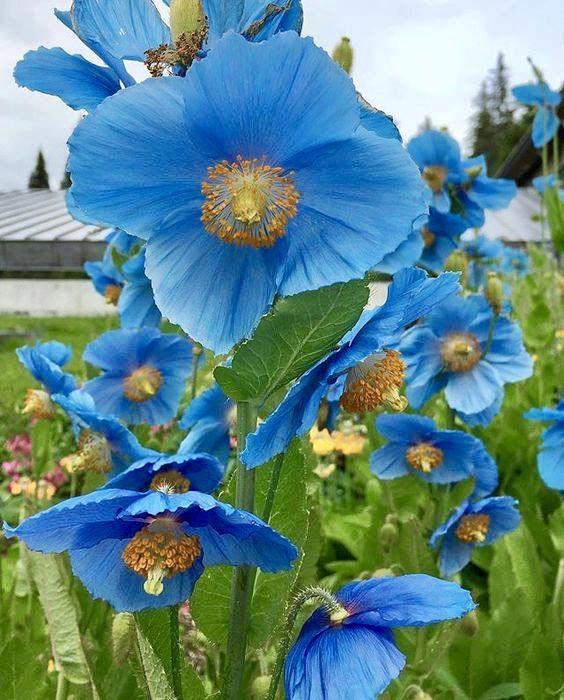
Image result for national flower of bhutan                                                                                                                                                                BLUE POPPY                                                                                                                                                                                                                                                                                                           The national flower of Bhutan is the Himalayan blue poppy (Meconopsis gakyidiana). In Bhutan, it grows to a height of 1 meter on the rocky mountain terrain, above the tree line at altitudes of 3500m to 4500m. Bhutanese tradition links this flower with the yeti of lore.
                                                                                                  The national symbols of Bhutan include the national flagnational emblemnational anthem, and the mythical druk thunder featured in all three. Other distinctive symbols of Bhutan and its dominant Ngalop culture include Dzongkha, the national language; the Bhutanese monarchy; and the driglam namzha, a seventeenth-century code on dress, etiquette, and dzong architecture. Natural symbols of Bhutan are its national flower, the Himalayan blue poppy; its national tree, the Himalayan cypress; its national bird, the raven; and its national animal, the takin.
                                                                                                                                                      These national symbols are established variously by law and tradition. While most laws codifying the national symbols of Bhutan such as the flag, emblem, and national anthem are modern, the tradition behind many of them is much older than the kingdom itself, deriving from Buddhist mythology. The druk thunder dragon is heavily associated with the Bhutanese state religion and has symbolized Bhutan ("Druk-yul") in particular since the late twelfth century. Traditional natural symbols, such as the raven and Himalayan cypress, possess not only admired characteristics, but religious meanings as well.

 Fairs and Festivals You Must See in Bhutan 


A land of prosperity and happiness, Bhutan is a country of pristine beauty and captivating heritage. From famous tourist destinations to popular fairs and festivals in Bhutan, each aspect of the country is equally enthralling. Cultural tourism in Bhutan is a major contributor to the travel sector in Bhutan. Although the natural beauty is what attracts tourists to Bhutan, we suggest you explore the cultural and heritage here with these festivals and fairs. Since you might be wondering how to find out about these festivals and fairs, we have curated a list of top 10 festivals in Bhutan you must see for an amazing stay in the land of happiness.
Punakha-Drubchen
Narrating the tales of the history of Bhutan, the glorious cultural festival of Punakha Drubchen is a celebration of the country’s victory over the invading neighbouring forces of Tibet. Celebrating the unification of Bhutan as a nation, the festive events reenact the scenes from the fights of Bhutan and Tibet. With no formal Bhutan army, locals came forward to ward off the attacks from Tibet. The locals militias now dress up as the soldiers of that time and enact the battle scenes. Starting as a celebration of Bhutan’s victory, today this festival is an annual event, celebrated with great pride and joy. Also, the winter home of Chief Abbott Je Khenpo of Bhutan, Punakha is one of the must-visit places to visit in Bhutan.
Attraction of the festival:
Reenactment of the battle between Bhutan and Tibet is the biggest attraction of this famous festival in Bhutan. With locals militia dressing up as Bhutanese warriors from the battle between Bhutan and Tibet, the event is an excellent option to witness the glorious history of the country.
Dates: 12-14 February 2019
Location: Punakha

Gomphu Kora Festival, Trashigang

Gomphu Kora Festival
A festival like none other in Bhutan, Gomphu Kora Festival is of prime importance to the locals of Trashigang. To understand the significance of the festival, we need to understand the legend behind the festival. The tale of the Ghompha goes back to 8th century when Guru Padmasambhava meditated in the cave for three days to vanquish the evil that was hiding in the cave. The word Ghompha means meditation cave and Kora means circumambulation. The name refers to the cave formed of a rock-face, which is next to a temple built as a tribute. During the festival, the devotees take a trip around the cave and the festival marks the victory of good over evil.
Attraction of the festival:
The trip around the cave is the major attraction on the festival. During the festival, the entire area gets lively and people flock to the site in the traditional finery to offer prayers to Guru Padmasambhava and seek his blessings.
Dates: 14-16 March 2019
Location: Trashigang

Paro Tshechu, Paro

Paro Tshechu
One of the most popular cultural events in Bhutan, Paro Tshechu is a big cultural celebrations during springtime. Celebrated in the city of Paro, the festival witnesses thousands of locals and tourists gathering around the courtyard of the Dzong to celebrate the deeds of Guru Rinpoche. Marked by the masked dance performed by lamas and laymen, the festival is meant to thank deities for their blessings. A must-see during every Bhutan tour, Paro Tshechu allows tourists to have an insight into the vibrant culture of Bhutan. At the end of the festival a four-storey high Buddhist religious scroll(thangkha) is unrolled. The scroll is said to be more than 350 years old.

List of airlines of Bhutan

Bhutan Airlines Tashi Air Pvt. Ltd , trading as  Bhutan Airlines , is Bhutan's first private airline. The airline resumed services o...